
Marine Electrical
Harmonic Distortion Surveys: What Your Yacht’s Power Can Reveal
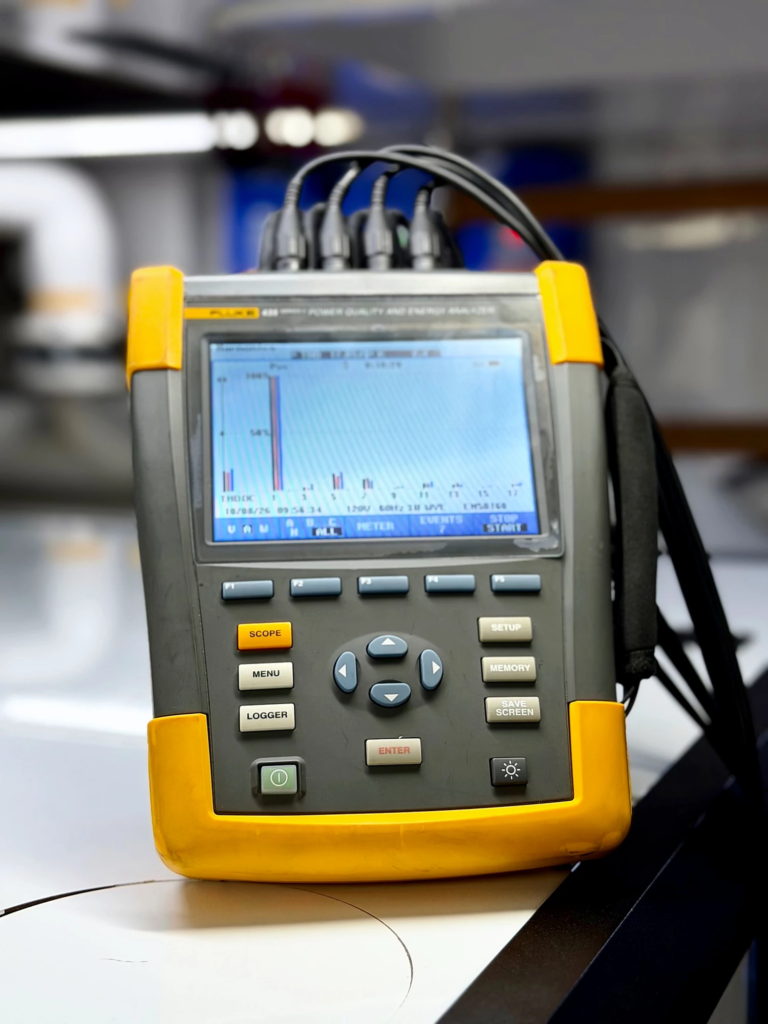
The lights work. The air conditioning runs. Nothing on the switchboard looks unusual. Yet the quality of the power feeding those systems can tell a different story.
A harmonic distortion survey looks beyond whether equipment switches on. It helps establish how voltage and current behave under load, so a vessel’s electrical condition can be assessed with measurements rather than assumptions.
What is harmonic distortion?
Electronic equipment can draw current in pulses rather than in a smooth waveform. These nonlinear loads introduce harmonics: electrical components at multiples of the supply frequency. On a yacht, drives, chargers and other power electronics make this a relevant part of a power-quality assessment.
Harmonics are not automatically evidence of a fault. The important questions are how much distortion is present, where it originates and how the connected equipment responds.
Why a normal voltage reading is only part of the picture
A spot check can confirm voltage at a particular moment. It does not, by itself, describe the waveform or capture how conditions change as loads switch on and off. Excessive harmonics can contribute to heating in electrical equipment and conductors. Understanding the operating conditions helps put those findings in context.
What should the survey evaluate?
The scope should reflect the vessel’s equipment, supply arrangement and reported symptoms. A useful discussion with the technical team covers:
- Voltage and current distortion: measurements of both, including the harmonic spectrum where appropriate.
- Operating loads: what was running when the measurements were recorded.
- Supply conditions: whether the vessel was on shore power or a generator, and which conditions need comparison.
- Timing: whether logging over a longer period is needed to investigate an intermittent issue.
- Next steps: findings explained in relation to the equipment and the survey’s agreed scope.
When is it worth discussing?
A refit, a change in major electrical equipment or an unresolved power-quality concern can be a sensible time to ask whether harmonic measurements belong in the diagnostic scope. Bring the symptoms and operating history to the conversation; the test plan should follow the question being investigated.
One reading does not justify a universal fix. Any recommendation for mitigation should follow an assessment of the source, the system and the equipment requirements.
Start with a clearer picture
Fine Line’s Diagnostics & Surveys service includes power-quality analysis. Share your vessel’s location, the equipment involved and what you have observed to discuss an appropriate assessment.
Further reading: Fluke: Effects of harmonics on electrical equipment and Fluke: Troubleshooting power harmonics.